Why Georgia House bill 1023 is bringing weapon detection to schools


Trusted by 100,000+ organizations globally
Key takeaways
- If Georgia House Bill 1023 passes, schools must use a weapons detection system at main entry points.
- Compliant weapons detection systems will need to be installed by July 2027 if the bill passes.
- Georgia House Bill 1023 will become law if passed by the House in April 2026.
- State officials have announced additional school safety grant funding to support this initiative.
What is Georgia House Bill 1023?
Georgia House Bill 1023 (GA HB 1023) is a proposed piece of legislation that would require all public schools in the state to install weapons detection systems at main entrance points.
If GA HB 1023 is enacted into law, all public schools across the state of Georgia will have to operate at least one weapons detection system at primary entrances where students enter school buildings. Doors that are locked, alarmed or not intended to be accessed by students under normal circumstances would be exempt from the new rules if GA HB 1023 is passed.
Why do lawmakers believe Georgia schools need weapons detection systems?
Georgia House Bill 1023 has been proposed in response to the September 2024 incident at Apalachee High School, Winder, GA. Lawmakers believe weapons screening systems may help to stop future incidents, as the Apalachee suspect was able to bring a weapon onto the site undetected.
The Apalachee incident, during which no weapon detection systems were in operation, was just one of many recorded across the state of Georgia between 2019 and 2024, influencing talks regarding new school safety bills.
In February 2026, House Majority Leader Chuck Efstration (R‑Mulberry) introduced Georgia House Bill 1023 in its current state, drawing bipartisan support from representatives such as Rep. David Wilkerson (D‑Powder Springs). On February 5th, 2026, GA HB 1023 passed the House Education Committee and is expected to advance to a full House vote later this year.
If passed, the Georgia school safety bill will require weapons detection systems to be installed in all public schools by July 2027; while the bill doesn’t include its own funding plan, Gov. Brian Kemp has approved ≈$21,000 in extra grant funding per school for 2025/26.

Get free expert grant assistance
- Find relevant funding opportunities
- Increase chances of securing funding
- Choose your weapons detection system
- Submit a successful application
Who will the Georgia school safety bill affect?
The Georgia school safety bill will affect all public schools in the state if passed by the House in 2026. Under the new law, all public schools will be required to install new or update current security technologies to function as weapons detection systems by July 2027.
Schools that currently have no weapons screening or upgradeable security systems in place will be most impacted by the new school safety bill. Institutions that are ineligible for grant funding or have already allocated awards elsewhere could also face compliance challenges.
How is a weapon detection system defined?
Under Georgia House Bill 1023, a school weapons detection system is defined as “a security technology or integrated set of devices designed to detect, through electronic, visual or analytical means, the presence of weapons” in reference to “firearms and hazardous objects”.
The bill also stipulates that compliant weapons detection systems “shall be capable of detecting the presence of weapons irrespective of whether such weapons are carried by or otherwise in the possession or control of an individual”, offering wider procurement guidance.
As GA HB 1023 does not specify the type of weapons screening technology to be installed at school entrances, school boards, administrators and security teams are provided some freedom to identify technologies that best meet unique campus and operational needs.
In accordance with the proposed bill, compliant weapons detection systems could include:
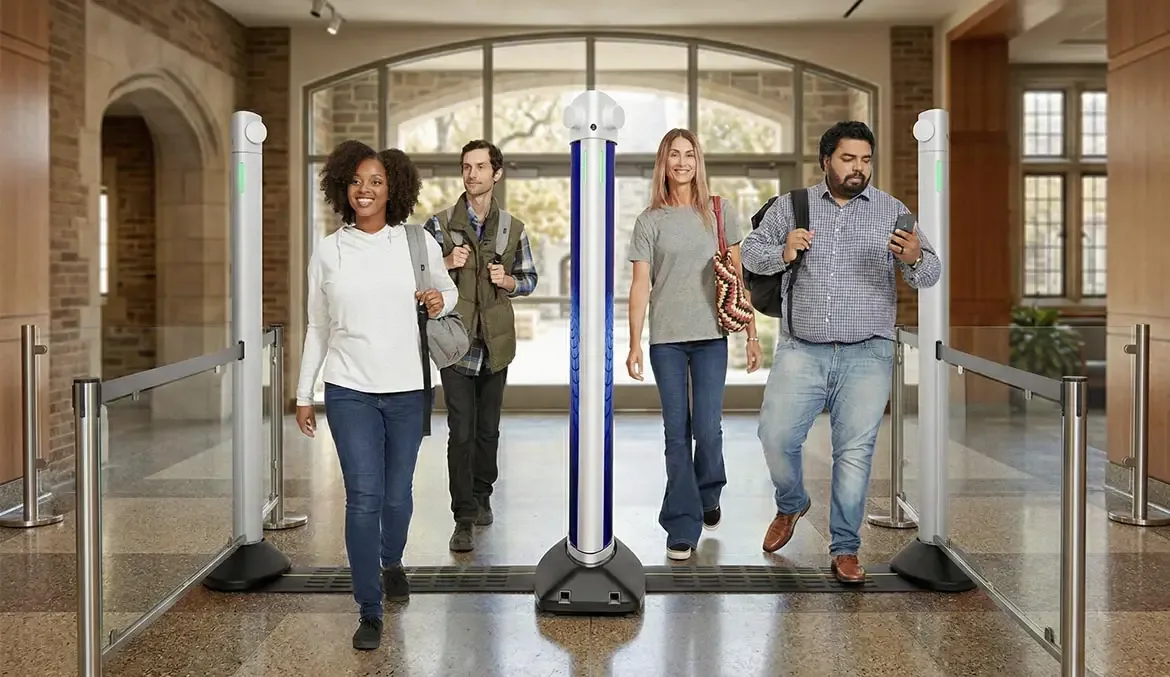
- Electronic systems, such as wave scanners and walkthrough weapons screening solutions, installed at main entrances to identify weapons via physical means.
- Visual systems, such as AI-powered video analytics software installed onto new or existing school security cameras, that can identify the presence of weapons visually.
- Analytical systems, such as electromagnetic sensors and video analytics software, capable of detecting concealed weapons and hazardous objects via analytical means.
Current status of Georgia House Bill 1023
The Georgia school weapon detection bill will become law before the start of the 2027 school year if passed by the House. As of February 2026, the bill has been passed by the House Education Committee and is slated to move to a full House vote in April 2026.
Should Georgia House Bill 1023 be passed by the House, all public schools across the state will be required to identify, buy and install compliant weapon detection systems by July 2027.
Is GA HB 1023 expected to pass the House vote?
Despite significant support, it remains unclear whether the Georgia school weapon detection bill will be passed by the House when voted on in April 2026, with some representatives and school district officials raising concerns about the high cost of compliance without mandated funding.
The main sponsor of the proposed legislation, House Majority Leader Chuck Efstration, said of his support during a House Education Subcommittee meeting held in early February 2026:
“As a practicing attorney here in Georgia, I am used to entering a Georgia courthouse most days, where I pass through security, which includes a weapons detection system. It’s my opinion that Georgia students deserve similar security when entering Georgia public schools.”
Many parents and teachers also support the bill, with Georgia resident and father of three Jeramie Cavallaro stating, “I mandate that the school commits to bringing my children back alive each and every day. And if that [weapons detection technology] was in place in every school, I would be able to relax as a parent and know that the threat has been mitigated.”
However, Rep. David Wilkerson, who has voiced some support for the bill, has also said of GA HB 1023 that “the key is that we have to have a solution that actually is funded, that’s reasonable, that makes sense based on the state”, a concern shared by Rep. Karen Lupton (D‑Chamblee) and select school district officials who believe implementation may be difficult.
Gretchen Walton, assistant superintendent of Cobb County School District, told lawmakers, “We have seventeen high schools, so they’re not all sweet little elementary schools with one entrance in the front and back”, adding, “At the beginning of the school day, a large portion of students come in through a different entrance…so we have a lot of operational concerns.”
How schools can be in compliance with GA HB 1023
Georgia public schools can ensure compliance with GA HB 1023 by identifying and installing weapons detection systems at all main entrances by July 2027. As detailed in the proposed bill, compliant weapons detection systems are those that can detect, through visual, electronic or analytical means, the presence of weapons in and out of a person’s possession.
School boards, administrators and security personnel are provided some degree of freedom as to which types of weapons detection technologies to use, with options to upgrade existing security technologies to perform weapons screening functions where possible.
Below are some examples of compliant weapons detection technologies that Georgia public schools may wish to explore to prepare for GA HB 1023, should the bill become law.
Visual weapons detection technologies
Visual weapons detection technologies include X‑ray devices and AI-powered security cameras designed to detect the presence of weapons in controlled areas. If a person holding a weapon moves through the detection area, operators are notified and asked to respond.
AI-powered cameras can be particularly beneficial, as the software can autonomously detect and remotely warn operators of concealed and open-carry weapons in real time. AI video analytics software can also be installed on existing security cameras to help reduce compliance costs.
Benefits associated with visual weapons detection technologies include:
- Low hardware demands; software can be installed onto existing compatible IP security cameras.
- Systems can detect wider threats such as aggressive behavior and suspicious movement.
- Via integrations, camera data can be used to trigger automated emergency lockdown responses.

Concealed Weapons Detection
A touchless screening system to detect concealed weapons (NAM only).

Visible Firearm Detection
Detect drawn firearms with AI-powered video analytics (U.S. only).

Security cameras
Enhance student and faculty safety with AI-powered security cameras.
Metal detection and wave scanning technologies
Metal detection and wave scanning weapons detection technologies include walkthrough weapons detectors and handheld scanners designed to detect specific visual and physical stimuli associated with weapons, without physical contact between individuals.
Wider school safety bills, such as South Carolina’s Metal Detectors in Schools Act, prioritize these types of technologies as recommended solutions. However, walkthrough detectors can be costly and time-consuming to install and handheld scanners must be operated by personnel.
Benefits associated with metal detection and wave scanning technologies include:
- Walkthrough devices and staff holding scanners can help to visually deter offenders.
- Metal detectors can act as physical barriers to prevent unauthorized access events.
- Scanners can accurately detect broader contraband items such as blades and ammunition.
Sensor-based weapons detection technologies
Sensor-based weapons detection technologies use specialized electromagnetic, radio wave, infrared, sound and other sensors to detect stimuli associated with weapons and hazardous objects. Sensors can be linked to additional security devices to inform automated responses.
Examples include imaging sensors that analyze radio wave distortions to identify weapons concealed by clothing, infrared sensors designed to detect the unique thermal signature of a fired weapon and sound sensors that can be used to detect gunshots and sounds of distress.
Benefits associated with sensor-based weapons detection technologies include:
- Small, subtle form factors can help to mitigate issues with vandalism and evasion.
- Sensors can be integrated into wider physical security systems to inform and enhance their operation.
- Sensors can provide extra information about security events such as break-ins and fights.
How are schools expected to fund weapons detection systems?
As of February 2026, the main complaint against GA HB 1023 has been the bill’s lack of built-in funding. Presently, Georgia public schools are expected to fund the procurement and installation of weapons detection systems using existing funds and school safety grants.
To help schools fund security system improvements, Gov. Brian Kemp has announced plans to increase school safety grant funding by $50 million. The amount of security grant funding available per school will increase by $21,635, providing a total award of almost $70,000.
Georgia educators can find and apply for school safety grant funding through resources such as:
Early preparation is key to compliance
Schools will need to comply with new regulations by July 2027 if GA HB 1023 is passed by the House. Therefore, they should begin reviewing their existing school security systems and planning required upgrades promptly, focusing on cost-effective security solutions that meet site-specific needs.
Whether GA HB 1023 becomes law or not, the proposal demonstrates a growing demand for more effective protections in modern schools.
FAQs
Have questions? We can help
Our video security experts can help you implement the right security system for your business.