Why businesses are adopting AI security systems


Trusted by 100,000+ organizations globally
To best-address modern threats, 46% of companies intend to increase their security budgets and 42% are planning to adopt AI security technologies. For business and property owners interested in the potential benefits of such solutions, below is a complete guide to AI security systems, including practical benefits, use cases and considerations to keep in mind.
What is an AI security system?
An AI security system is a network of physical security devices that use artificial intelligence to engage swift, informed responses to security threats.
Components like cameras, sensors and access control systems use advanced technologies like machine learning and computer vision to identify subtle patterns and anomalies in security data that may otherwise go overlooked.
For a security system to be considered AI-powered, it must use AI technologies such as machine learning to identify, analyze and respond to threats in real time. Configuring traditional components like cameras and building access control systems to automatically address common threats in an AI-based security system helps humans better understand and respond to security incidents.

Make smarter security decisions with AI
- Unify video security and access control
- Reduce false alarms and noise
- Detect risks and verify incidents faster
- Improve awareness with real-time alerts
How do AI security systems work?
AI security systems work by analyzing vast amounts of data continuously and in real time to understand expected activities and engage responses to potential threats.
Core components and management systems use a few specific types of AI to perform critical security functions.
- Machine learning enables systems to identify patterns in and learn from security data autonomously. Through machine learning, AI security systems can be trained to spot threatening actions and objects and adjust operations in response to live events.
- Neural networks are AI-driven algorithms modeled after the human brain that help AI security systems perform complex analytics tasks. Neural networks enable systems to become more accurate over time as the algorithm analyzes more site-specific events.
- Computer vision enables devices that process visual data, like AI security cameras, to identify objects and actions in images and videos. As these cameras are exposed to more site-specific footage, computer vision algorithms become more accurate and nuanced.
Artificial intelligence in security systems enables individual components and the system to respond to subtle threats autonomously. For example, if an AI camera detects a person in a secure area at an unusual time, it can send an alert to humans detailing the event and instruct wider devices such as alarms and smart locks to engage.
How do traditional and AI-based security systems differ?
Traditional and AI-based security systems differ in their approach to tackling security threats.
In a traditional environment, responses are reactive. Components like sensors and cameras capture evidence of threats but cannot understand the context of an event, meaning human operators must continuously observe and analyze incoming data to plan a reactive response.
Artificial intelligence security systems allow for proactive responses. AI security components continuously analyze incoming data for signs of anomalous activities and predefined threats, enabling systems to enact instant responses while providing humans with data-rich updates.

Get your free AI security checklist
- Learn how AI reduces incidents
- Discover predictive safety insights
- Explore AI-powered security tools
- Improve compliance & help protect staff
The key components of an AI security system
AI security systems leverage several core components to help teams identify and address wide-ranging threats. Property owners can deploy unique configurations of hardware and software solutions to proactively address site-specific hazards and threats.
Security cameras
AI cameras use intelligent video analytics software to understand the content and context of live video footage. Cameras that cover important areas can be trained to identify specific objects and events, as well as anomalous activities that require further investigation.
These cameras can detect active threats like aggressive behaviors and visible firearms, as well as subtle threats like people or vehicles loitering around buildings.
If the system detects a threatening or anomalous event, it will flag and label clips in a linked video management system (VMS), notify operators and may program wider security devices to respond.
Environmental sensors
Sensors connected to the Internet of Things (IoT) capture live data associated with changes in the environment, then use AI to generate insights and inform responses.
IoT sensors in these security systems typically use edge AI to analyze data, meaning that analytics processes are performed at the device to help reduce latency and protect sensitive data from cyberattacks.
AI-powered sensors can detect and warn operators of wide-ranging threats such as sounds consistent with a break-in, gunshots, odd motion and fires. When deployed as part of an AI security system, sensor data can trigger wider solutions like cameras and alarms.
Access control systems
AI technologies can enhance the capabilities of access control systems by strengthening credential security and enhancing investigative processes.
AI tools like facial recognition software are used to secure high-risk areas behind difficult-to-fabricate biometric credentials, helping operators to bypass issues associated with lost or stolen access tokens.
AI is also used to detect and warn security teams of suspicious access events. AI security systems can use machine learning to identify anomalous access requests and unexpected activities, enabling stakeholders to address insider threats and credential misuse.
Security management systems
Security management systems provide operators with a digital platform from which all elements of a security system can be viewed and adjusted. AI technologies add extra functionality to these platforms, enabling operators to identify suspicious events across multiple integrated systems.
AI-based security management systems can analyze vast amounts of data associated with video security, access control, sensor and network security solutions.
Operators can program the system to send site-specific alerts warning of complex threats, use AI false alarm filtering to mitigate false alerts and use natural language to find data associated with specific events.
The benefits of artificial intelligence in security systems
By choosing to integrate artificial intelligence into security systems, property owners and site managers can take a proactive approach to addressing and preventing security incidents.
AI technologies enable operators to not only identify and respond to threats more efficiently but also gain a deeper understanding of day-to-day events to help inform practical improvements.
Better security awareness
AI-based security solutions continuously analyze real-time data across access control, video security, sensor and cybersecurity systems, enabling human operators to maintain a holistic view of potential threats.
Should a suspicious or dangerous event occur, AI systems ensure relevant personnel are provided all the information required to respond safely and effectively.
Improved detection accuracy
Innocuous events can accidentally trigger traditional security devices, such as shadows moving across sensors and animals passing by cameras. As AI security systems can apply contextual reasoning to activation events, they can help to minimize false alerts.
Reduced mental fatigue
AI-based security systems reduce a business’ reliance on human personnel to continuously observe security feeds, helping to minimize fatigue while ensuring operators remain informed of genuine threats.
Mental fatigue can influence errors in high-risk, data-heavy work environments, with studies linking fatigue to a more than 300% increase in behavioral errors.
Proactive threat detection
As AI security systems both capture and analyze real-time data, they can help businesses adopt a proactive security posture.
Over time, the system can learn expected behaviors and activities unique to the site in question, meaning staff can be informed of anomalous events that may otherwise be missed and enabled to address emerging risks before effects are felt.
Enhanced workplace safety
Alongside security threats, these systems can be used to detect workplace hazards like PPE misuse, machine faults, chemical spills and unsafe behaviors.
Studies have shown that AI-powered workplace safety systems can help to reduce accidents by as much as 75%, with modern AI-based hazard detection solutions able to achieve accuracy rates as high as 97%.
Where are AI security systems commonly used?
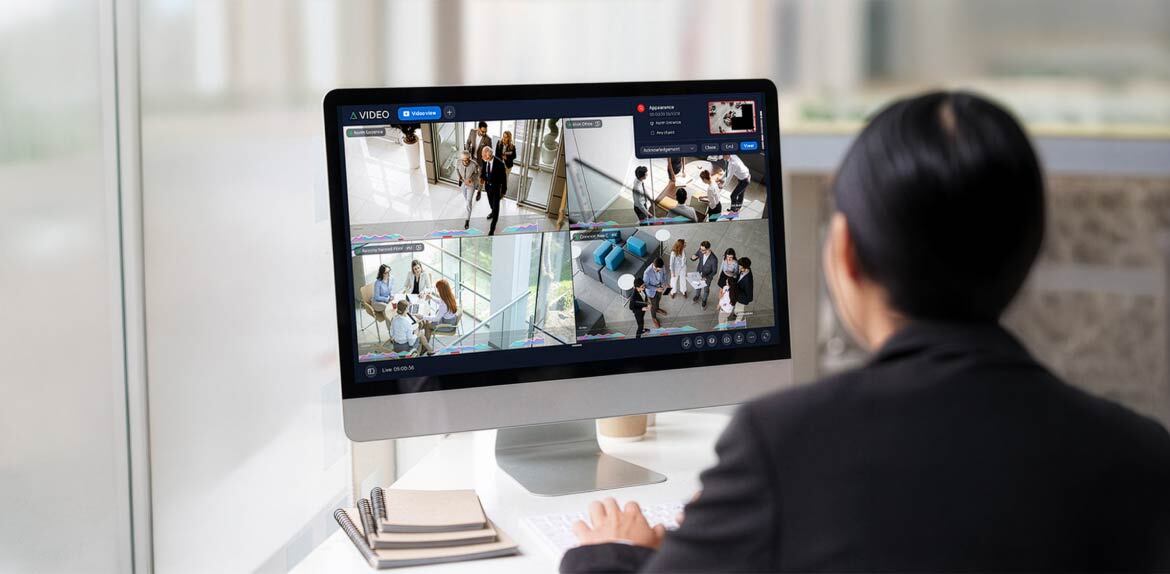
Adoption rates for AI security systems are rising across many major industries, with reports suggesting 64% of security leaders are currently using or planning to implement AI solutions.
Below are some examples of real-life use cases for AI systems in professional environments:
- Commercial buildings: Security systems, such as cameras, help owners and operators of commercial buildings to detect common threats like loitering, tailgating and unauthorized access.
- Retail environments: Devices like facial recognition cameras help store managers combat shrinkage through shoplifting by accurately detecting suspicious behaviors and known offenders to help facilitate safer environments for customers.
- Industrial facilities: In industrial environments, AI security systems help operators to deter criminality, improve workplace safety and better-maintain high-value machines.
- Schools and colleges: Security systems help to safeguard students by providing security teams access to high-quality, real-time information.
- Construction sites: These systems help construction firms address common security and safety issues across complex sites, including safeguarding high-value equipment, restricting access to high-risk areas and improving site safety.
- Healthcare facilities: Security teams can leverage AI security system data to identify and address wide-ranging threats, allowing for the deployment of sensor-activated panic alarm systems, real-time hazard detection systems and automated lockdown solutions.
What to look for when choosing an AI security system
For an AI security system to be truly effective, it must account for the unique infrastructural and organizational requirements of the facility in question.
Before finalizing adoption plans, ensure the desired technologies meet the below requirements:
- Detection accuracy: Prioritize equipment and analytics tools with detection accuracy rates above 90% to help reduce issues with false alerts and improve response times.
- Hardware quality: AI tools can more accurately detect threats in high-quality images and datasets. Prioritize business security cameras and detection devices with high-resolution sensors.
- Analytics features: Prioritize AI tools with analytics features that can help to address site-specific threats; e.g. object detection, facial recognition, behavioral analytics, etc.
- Integration capabilities: Look for security solutions that support open standards like ONVIF and OpenAPI specifications to allow for integration with wider systems.
- Regulatory readiness: Prioritize AI solutions with native data security tools and protections to maintain compliance with data privacy laws like CCPA and GDPR.
- Scalability and extensibility: Choose AI security solutions that can be scaled and updated as needs and threats change to help ensure future-proof security operations.
Are AI security systems worth it?
AI security systems are worth it for property owners and operators who regularly face safety and security threats, issues with false alerts and challenges associated with operator fatigue.
The ability of these solutions to proactively address subtle threats and keep operators informed of risks without continuous oversight can help to improve security awareness and outcomes.
Provided leaders can budget for upfront costs, AI systems can also become cost-effective over time by limiting the need for high-cost, resource-draining manual management.
Employ a proactive approach to security
The smart, autonomous capabilities of AI security systems are helping businesses across major industries improve security outcomes and deter criminality, while also enabling human security personnel to make more informed decisions and avoid fatigue-induced errors.
Avigilon offers a range of intelligent, intuitive AI security solutions designed with integration and customization in mind. Future-proof your organization and employ a proactive approach to business security management by adopting Avigilon’s AI-powered security solutions today.
AI security system FAQs
Have questions? We can help
Our video security experts can help you implement the right security system for your business.